Field With Flowers Near Arles
by VINCENT VAN GOGH who wrote to his brother Theo about this painting in 1888:
‘A meadow full of very yellow buttercups, a ditch with iris plants with green leaves, with purple flowers, the town in the background, some grey willow trees—a strip of blue sky. If they don’t mow the meadow I’d like to do this study again, because the subject matter was really beautiful and I had trouble finding the composition. A little town surrounded by countryside entirely covered in yellow and purple flowers. That would really be a Japanese dream, you know.’
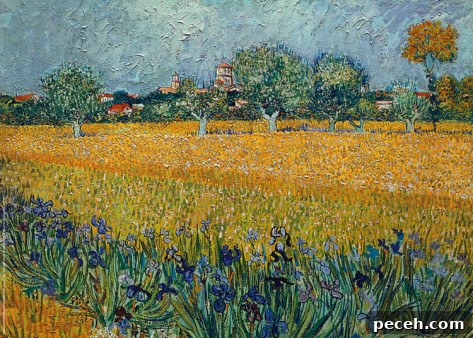
This work captures Van Gogh’s fascination with vivid color contrasts and rural landscapes. The foreground’s carpet of yellow buttercups balances with bands of purple irises and the blue strip of sky, while the distant town and willows add depth and a quiet human presence. Van Gogh’s letter to Theo reveals how strongly he felt about revisiting the scene to resolve compositional challenges and to preserve the fleeting arrangement of blooms.
Painted in 1888, the scene exemplifies Van Gogh’s late Arles period, when he often explored bright complementary colors and simplified forms to express emotion through landscape. The combination of a flowering meadow, the line of willows, and the small town silhouette creates a tranquil yet vibrant composition that reads like a memory or a dream—an effect Van Gogh compared to Japanese aesthetics.
If you wish to view a high-resolution image of this painting, search for “Field With Flowers Near Arles” on major art platforms or museum collections that host Van Gogh’s works. Viewing the painting closely reveals Van Gogh’s energetic brushwork and the way he layered colors to achieve luminosity and movement across the field.
For collectors, students, or anyone interested in 19th-century post-Impressionism, this painting is a clear example of Van Gogh’s ability to transform a simple pastoral scene into a powerful study of color, light, and composition. The work invites repeated viewing: each look uncovers subtle shifts in the artist’s handling of paint and his emotional response to the Provençal landscape.